What Is a Private Cloud?
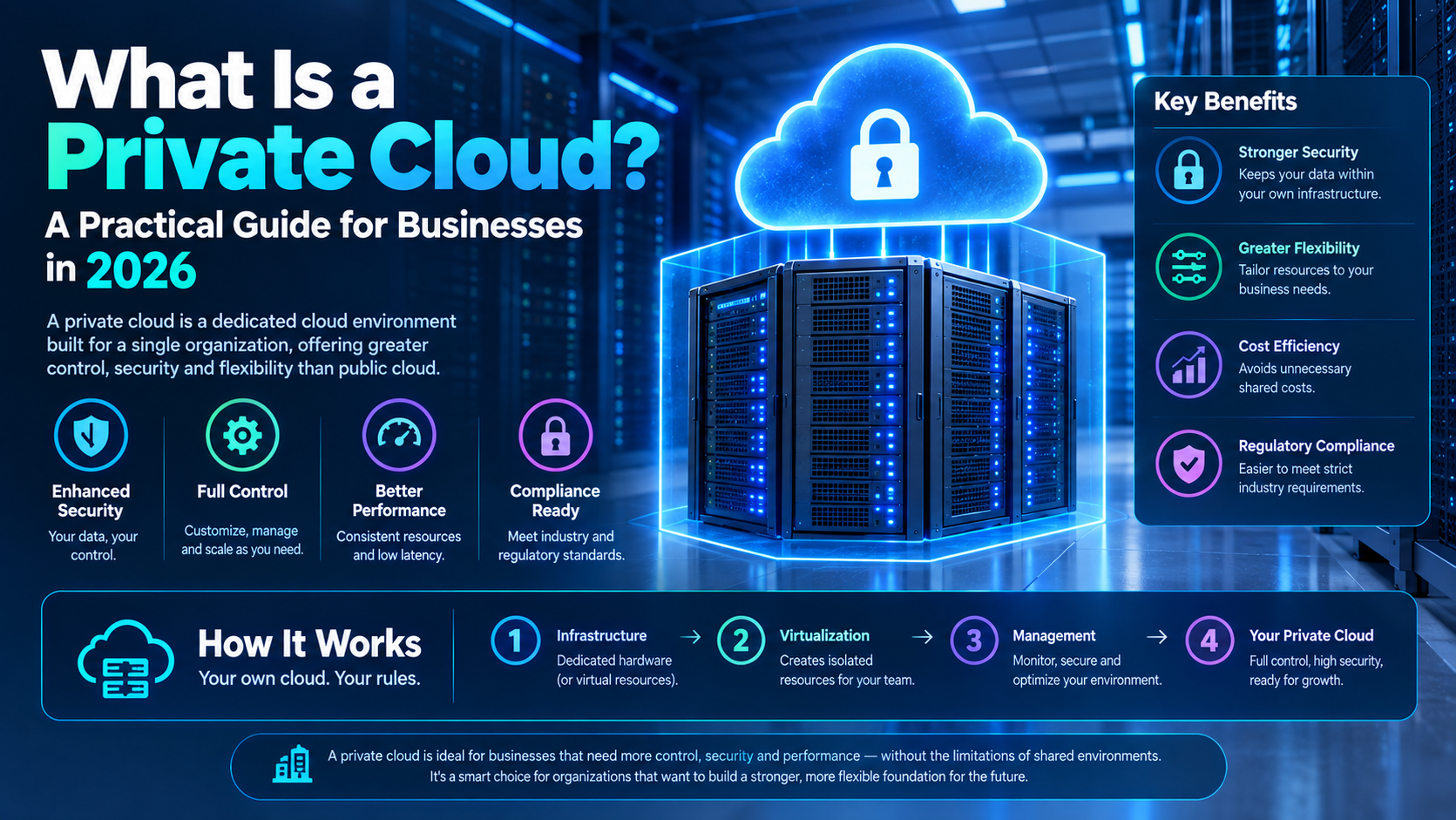
A Private Cloud is a cloud computing environment dedicated to one organization instead of being shared with multiple customers. It provides cloud-style features such as virtualization, automation, scalability, resource management, and centralized control while giving a business greater control over its infrastructure.
Unlike traditional public cloud services, a Private Cloud environment is designed for a single organization. Therefore, businesses can customize infrastructure according to their applications, security requirements, compliance needs, and performance expectations.
For example, companies handling sensitive customer information, financial data, healthcare records, or business-critical applications may consider Private Cloud hosting when greater control and isolation are important.
However, Private Cloud is not automatically the right choice for every organization. The decision depends on workload requirements, budget, technical expertise, security expectations, and long-term infrastructure plans.
How Does Private Cloud Infrastructure Work?
A Private Cloud infrastructure combines physical servers, storage, networking, virtualization, and management software to create a dedicated cloud environment.
Generally, Private Cloud works through several important layers.
Virtualization in Private Cloud
First, virtualization divides physical computing resources into multiple virtual machines or workloads. This allows businesses to use server resources more efficiently.
Virtualization also makes it easier to allocate CPU, RAM, storage, and networking resources according to application requirements.
Private Cloud Management Layer
Next, a management layer controls the virtual machines, storage, networking, users, and available resources.
As a result, administrators can monitor infrastructure and manage workloads from a centralized platform.
Automation and Resource Management
Automation is another important part of Private Cloud infrastructure. Businesses can automate tasks such as provisioning, scaling, monitoring, backups, and resource allocation.
Consequently, IT teams can reduce repetitive manual work and respond more quickly when infrastructure requirements change.
Private Cloud vs Public Cloud: What’s the Difference?
The main difference between Private Cloud vs Public Cloud is infrastructure ownership and resource isolation.
A public cloud generally uses shared infrastructure where multiple customers run workloads on the provider’s platform. In contrast, a Private Cloud is dedicated to one organization.
|
Feature |
Private Cloud |
Public Cloud |
|
Infrastructure |
Dedicated |
Shared |
|
Resource Control |
High |
Provider-controlled |
|
Customization |
High |
Usually more limited |
|
Security Isolation |
Strong |
Provider-managed |
|
Scalability |
Scalable |
Highly scalable |
|
Management |
Self or managed |
Mostly provider-managed |
|
Cost Structure |
Can require higher investment |
Often pay-as-you-go |
However, public cloud can be suitable for businesses that want rapid deployment and flexible usage. On the other hand, Private Cloud can provide greater control for organizations with specific security or compliance requirements.
Types of Private Cloud
There are several Private Cloud deployment models. The right option depends on where the infrastructure is hosted and who manages it.
On-Premises Private Cloud
An on-premises Private Cloud is deployed inside an organization’s own facility.
The company owns or controls the servers, networking equipment, storage, and other infrastructure. Therefore, this model provides extensive control but also requires significant technical expertise and infrastructure investment.
Hosted Private Cloud
A hosted Private Cloud is located in a third-party data center but remains dedicated to one organization.
This option can reduce the need for businesses to maintain their own physical data center. Additionally, a hosting provider may handle hardware, networking, monitoring, and other infrastructure tasks.
Virtual Private Cloud (VPC)
A Virtual Private Cloud (VPC) is a logically isolated environment within a larger public cloud infrastructure.
Although VPC environments provide network isolation and customization, they are not necessarily the same as a dedicated physical Private Cloud.
Therefore, businesses should understand the difference before selecting a cloud architecture.
Managed Private Cloud
A Managed Private Cloud is operated and maintained by a cloud or hosting provider.
The provider may manage infrastructure monitoring, security updates, backups, networking, and other technical tasks.
As a result, managed Private Cloud can be useful for organizations that want dedicated infrastructure without handling every administrative responsibility themselves.
Who Needs Private Cloud?
A Private Cloud can support different types of businesses and workloads. Nevertheless, the benefits depend on the organization’s specific requirements.
Private Cloud for Small Businesses
Private Cloud for small business environments can be useful when a company needs dedicated infrastructure, better control, or specific security requirements.
However, smaller organizations should carefully evaluate the total cost and management requirements before choosing Private Cloud.
Private Cloud for Startups
Startups with predictable workloads and specific data requirements may consider Private Cloud as they grow.
For instance, a startup processing sensitive customer information may require stronger infrastructure control than a basic shared hosting environment provides.
Private Cloud for eCommerce
Private Cloud for eCommerce businesses can provide dedicated resources for websites, databases, payment systems, and other critical applications.
During sales campaigns or seasonal traffic increases, scalable infrastructure can help businesses handle changing workloads.
Private Cloud for Developers
Developers can use Private Cloud environments to create isolated development, testing, staging, and production environments.
Furthermore, dedicated infrastructure can make it easier to customize operating systems, networking, security policies, and deployment environments.
Private Cloud for Agencies
Digital agencies managing multiple websites, applications, or client projects can use Private Cloud infrastructure to separate workloads and maintain centralized control.
As a result, agencies can create customized environments for different projects while maintaining control over the underlying infrastructure.
When Should You Consider Private Cloud?
A business may consider Private Cloud when it needs more infrastructure control than traditional shared or public environments provide.
For example, Private Cloud may be considered when a company needs:
- Dedicated computing resources
- Stronger workload isolation
- Greater infrastructure customization
- Specific compliance requirements
- Predictable performance
- Custom networking configurations
- Control over security policies
- Dedicated infrastructure for sensitive workloads
However, businesses should not select Private Cloud simply because it sounds more secure or advanced. Instead, they should compare infrastructure requirements, costs, management responsibilities, and business objectives.
What Are the Benefits of Private Cloud?
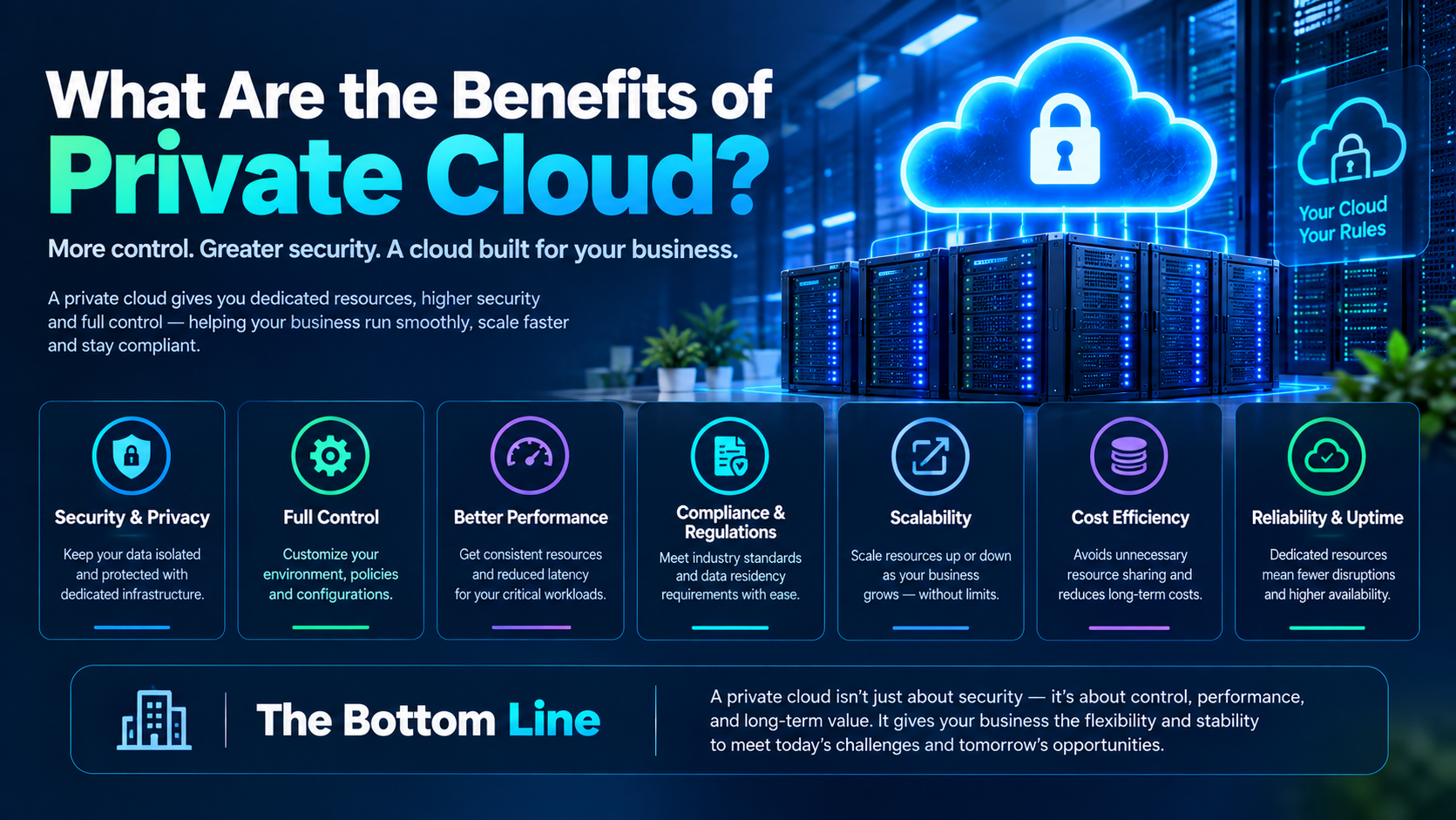
There are several potential benefits of using Private Cloud infrastructure.
Better Security and Isolation
Private Cloud security can benefit from dedicated infrastructure and controlled access.
Because resources are dedicated to one organization, businesses can design security policies around their own applications and data.
Nevertheless, dedicated infrastructure does not automatically guarantee security. Proper configuration, monitoring, patching, access control, and backups are still essential.
Predictable Performance
Private Cloud environments can provide dedicated resources for business applications.
Therefore, organizations can have greater control over resource allocation and workload performance.
Greater Compliance Control
Organizations operating under regulatory requirements may need specific controls over data, access, storage, and infrastructure.
A Private Cloud can make it easier to design infrastructure around these requirements.
For example, businesses may need to consider PCI-DSS compliance, GDPR requirements, or industry-specific security controls.
More Customization
Private Cloud infrastructure can be customized according to workload requirements.
Businesses can configure networking, storage, operating systems, security policies, monitoring, and resource allocation according to their technical needs.
More Predictable Infrastructure Costs
Although Private Cloud can require more investment than basic hosting, businesses with predictable workloads may benefit from more predictable infrastructure planning.
Therefore, organizations should calculate the total cost rather than comparing only monthly server prices.
Private Cloud Cost: What Does It Actually Cost?
Private Cloud cost depends on several factors, including hardware, storage, networking, software licenses, security tools, management, support, and data center requirements.
On-Premises Private Cloud Costs
An on-premises Private Cloud can require significant upfront investment.
Costs may include:
- Physical servers
- Storage systems
- Networking equipment
- Firewalls
- Backup infrastructure
- Software licenses
- Data center space
- Electricity
- Cooling
- IT staff
- Maintenance
Consequently, the initial investment can be considerable.
Hosted Private Cloud Pricing
Hosted Private Cloud pricing is usually based on the infrastructure and services included in the package.
The final price may depend on:
- CPU resources
- RAM
- Storage capacity
- Bandwidth
- Backup requirements
- Security services
- Management services
- Support level
Therefore, businesses should request a customized Private Cloud cost estimate based on their actual workload.
Additional Private Cloud Costs
In addition to infrastructure costs, businesses may need to budget for:
- Migration
- Backup
- Disaster recovery
- Security monitoring
- Software licensing
- Technical support
- Scaling
- Compliance requirements
As a result, comparing only the advertised monthly price may not provide an accurate picture of total Private Cloud pricing.
Private Cloud Security and Compliance
Security is one of the main reasons organizations consider Private Cloud infrastructure.
However, security depends on how the environment is designed, configured, and managed.
Private Cloud and PCI-DSS
Businesses processing card payments may need to meet PCI-DSS compliance requirements.
A Private Cloud can provide greater infrastructure control, which may help organizations implement required security controls.
However, infrastructure alone does not make an environment PCI-DSS compliant. Organizations must still implement and maintain the required controls.
Private Cloud and GDPR
Organizations handling personal data may need to consider GDPR requirements.
A Private Cloud can provide greater control over where workloads and data are hosted. Nevertheless, businesses remain responsible for implementing appropriate privacy and security practices.
Private Cloud and HIPAA
Healthcare organizations handling protected health information may have specific compliance requirements.
A suitable Private Cloud architecture can help organizations design infrastructure around required security and access controls.
However, compliance depends on the complete environment, policies, processes, and applicable agreements—not simply the cloud deployment model.
Zero-Trust Security
Private Cloud environments can also incorporate zero-trust security principles.
For example, organizations can apply:
- Identity-based access
- Multi-factor authentication
- Network segmentation
- Least-privilege access
- Continuous monitoring
- Encryption
Therefore, Private Cloud security should be treated as an ongoing process rather than a one-time configuration.
Private Cloud for eCommerce Businesses
eCommerce businesses often require reliable infrastructure because website availability directly affects customer experience.
Payment Security
Private Cloud infrastructure can provide greater control over systems handling sensitive payment-related workloads.
Handling Traffic Spikes
Online stores may experience significant traffic increases during sales, holidays, or marketing campaigns.
Therefore, scalable Private Cloud resources can help businesses adjust infrastructure according to demand.
Checkout Availability
Checkout systems, databases, APIs, and payment-related applications are critical components of an online store.
Consequently, businesses should design Private Cloud infrastructure with redundancy, monitoring, backups, and disaster recovery in mind.
Private Cloud for Developers and Agencies
Developers and agencies often need flexible environments for multiple applications.
A Private Cloud can support:
- Development environments
- Testing environments
- Staging environments
- Production applications
- Databases
- APIs
- Container workloads
- Internal tools
Furthermore, teams can create separate environments for different projects while maintaining centralized infrastructure management.
How to Choose a Private Cloud Provider
Choosing the right Private Cloud provider requires more than comparing monthly prices.
Before selecting a provider, evaluate:
Infrastructure
Check the available CPU, RAM, storage, networking, and server hardware.
Security
Review firewall options, access controls, monitoring, backups, and security practices.
Reliability
Ask about uptime, redundancy, backup systems, and disaster recovery options.
Management
Determine whether the environment is self-managed or whether the provider offers managed Private Cloud services.
Support
Check the provider’s technical support availability and response process.
Scalability
Make sure the infrastructure can grow as your workload increases.
Ultimately, the right Private Cloud provider should match your technical requirements, budget, security expectations, and growth plans.
Managed Private Cloud vs Self-Managed Private Cloud
Businesses can choose between managed and self-managed infrastructure.
With self-managed Private Cloud, the organization is responsible for infrastructure administration, updates, monitoring, security configuration, and troubleshooting.
In contrast, managed Private Cloud allows a provider to handle some or many infrastructure management tasks.
Therefore, organizations with limited internal IT resources may consider managed infrastructure, while experienced IT teams may prefer greater administrative control.
Private Cloud for AI Workloads
AI and machine learning workloads can require significant computing resources.
A Private Cloud can provide dedicated infrastructure for:
- AI model training
- Machine learning
- Data processing
- GPU workloads
- Inference
- Research environments
Furthermore, organizations can customize hardware, networking, storage, and security according to their AI requirements.
For businesses working with sensitive datasets, dedicated infrastructure may also provide greater control over where data is processed and stored.
Why Are Some Businesses Moving Back to Private Cloud?
Some organizations that previously moved workloads to public cloud environments have reconsidered where certain applications should run.
This process is sometimes called cloud repatriation.
Businesses may evaluate Private Cloud when they experience:
- Predictable workloads
- Increasing public cloud costs
- Specific compliance requirements
- Data control requirements
- Performance requirements
- Long-term infrastructure needs
However, cloud repatriation is not automatically suitable for every business. The decision depends on workload characteristics and the total cost of each infrastructure model.
How to Get Started With Private Cloud
Moving to Private Cloud requires proper planning.
Step 1: Assess Your Requirements
Start by identifying:
- Current workloads
- CPU requirements
- RAM requirements
- Storage requirements
- Bandwidth
- Security needs
- Compliance requirements
- Backup requirements
Step 2: Choose a Deployment Model
Next, decide whether you need:
- On-premises Private Cloud
- Hosted Private Cloud
- Managed Private Cloud
- Virtual Private Cloud
Each option has different costs, management requirements, and levels of control.
Step 3: Choose Managed or Self-Managed Infrastructure
If your team has strong technical expertise, self-managed infrastructure may be an option.
On the other hand, managed infrastructure can reduce the administrative workload.
Step 4: Plan Your Cloud Migration
Before starting cloud migration, create a detailed migration plan.
Identify which applications should move first, which dependencies exist, and how downtime will be handled.
A phased migration can reduce risk and make troubleshooting easier.
Step 5: Test Security and Performance
Finally, test:
- Performance
- Security
- Backups
- Network connectivity
- Application compatibility
- Disaster recovery
- Monitoring
As a result, your organization can identify problems before moving critical production workloads.
Common Private Cloud Mistakes to Avoid
Businesses should avoid several common mistakes when implementing Private Cloud.
Ignoring Total Cost
Do not calculate only server costs. Consider software, support, migration, backups, security, maintenance, and scaling.
Choosing More Infrastructure Than Needed
More resources do not always mean better performance.
Instead, select infrastructure based on actual workload requirements.
Ignoring Backups
A Private Cloud still requires reliable backups and disaster recovery.
Therefore, implement backup policies before moving important applications.
Poor Security Configuration
Dedicated infrastructure does not eliminate security risks.
Use strong authentication, access controls, firewalls, monitoring, patching, and encryption.
No Migration Strategy
Moving workloads without proper planning can create downtime and compatibility issues.
Consequently, create and test a migration plan before moving production systems.
Private Cloud FAQs
Is Private Cloud More Expensive Than Public Cloud?
Private Cloud can have higher infrastructure and management costs, especially when an organization owns and operates the hardware.
However, the total cost depends on workload size, infrastructure model, management requirements, and usage patterns.
Can a Small Business Afford Private Cloud?
Yes, some small businesses can use Private Cloud, particularly through hosted or managed Private Cloud services.
However, the business should first evaluate whether the additional control and dedicated infrastructure justify the cost.
Is Private Cloud More Secure Than Public Cloud?
Private Cloud can provide greater control and resource isolation. However, security depends on proper configuration, monitoring, access controls, patching, and management.
Therefore, Private Cloud should not automatically be considered more secure simply because it is dedicated.
What Is the Difference Between Private Cloud and a Dedicated Server?
A dedicated server provides physical resources to one customer.
A Private Cloud is a broader cloud infrastructure model that can use multiple servers, virtualization, storage, networking, automation, and centralized management.
Therefore, a dedicated server can be part of a Private Cloud infrastructure, but the two concepts are not identical.
What Is the Difference Between Private Cloud and Public Cloud?
Private Cloud infrastructure is dedicated to one organization, while public cloud infrastructure serves multiple customers through a provider’s shared platform.
The right model depends on requirements such as control, customization, scalability, security, and budget.
Do I Need a Private Cloud for eCommerce?
Not every eCommerce business needs Private Cloud.
However, businesses with sensitive data, predictable high workloads, specific compliance requirements, or complex infrastructure needs may consider Private Cloud hosting.
Can I Move From Public Cloud to Private Cloud Later?
Yes. Businesses can migrate workloads from public cloud environments to Private Cloud infrastructure.
However, successful migration requires workload assessment, dependency mapping, infrastructure planning, testing, and a carefully managed migration process.
Conclusion: Is Private Cloud Right for Your Business?
A Private Cloud provides a dedicated cloud environment with greater control, customization, and resource isolation.
For businesses with specific security, compliance, performance, or infrastructure requirements, Private Cloud can be an important option. At the same time, organizations should compare Private Cloud with public cloud, VPS hosting, dedicated servers, and hybrid cloud solutions before making a decision.
The best approach is to evaluate your workloads, budget, security requirements, technical resources, and long-term growth plans.
If you are considering Private Cloud hosting, a provider can assess your infrastructure requirements and prepare a custom Private Cloud cost estimate based on your workload.