Abstract
Best GPU Servers for Agricultural AI Projects are becoming essential for modern smart farming systems. Agriculture is increasingly using artificial intelligence, drones, satellite imagery, IoT sensors, and climate-monitoring platforms to improve crop management and productivity. These technologies generate large volumes of data that require powerful computing resources for efficient processing.
Modern farming systems rely on satellite imagery, drone surveillance, IoT sensors, and climate-monitoring platforms that continuously generate large volumes of data. Processing these datasets efficiently requires powerful computing resources, making GPU servers an essential component of modern agricultural infrastructure.
Agriculture is experiencing a major technological transformation driven by artificial intelligence. To power these modern farming systems, deploying high-performance GPU Servers for Agricultural AI projects has become essential.
Modern farming systems increasingly depend on satellite imagery, drone surveillance, IoT sensors, and climate-monitoring platforms that continuously generate large volumes of data. Processing these datasets efficiently requires powerful computing resources, making GPU servers an essential component of modern agricultural infrastructure.
Among the most widely adopted GPU solutions are theNVIDIA RTX PRO 6000 Blackwell Max-Q and the 2x NVIDIA A100 80GB . Although both accelerators provide excellent computational capabilities, they are designed for different workloads.
The NVIDIA RTX PRO 6000 Blackwell Max-Q is particularly suitable for universities, research laboratories, and medium-scale AI applications due to its balance between performance and affordability. In contrast, the 2x NVIDIA A100 80GB is optimized for enterprise environments where massive datasets and distributed deep-learning models require exceptional throughput and scalability.
This article examines the importance of GPU computing in agriculture, compares the architectural characteristics o fNVIDIA RTX PRO 6000 Blackwell Max-Q and 2x NVIDIA A100 80GB , and evaluates their suitability for various agricultural AI applications.
1. Introduction to GPU Servers
GPU Servers act as the backbone of modern computing. Today, these systems drive heavy AI models and deep learning tasks efficiently. In smart farming, high-performance hardware is crucial for data processing. Furthermore, agribusinesses use these systems to run computer vision tools. In addition to this, they help analyze real-time drone data seamlessly. Therefore, relying on dedicated computing power avoids system bottlenecks.
Agriculture has evolved from conventional farming practices into highly intelligent, data-driven systems. Today, modern farming increasingly depends on machine learning models, computer vision, and automation tools to optimize crop yields and manage resources efficiently. In this technological evolution, choosing the right GPU Servers for Agricultural AI projects plays a critical role.
The increasing use of drones, satellite imaging, and IoT sensors has resulted in the generation of enormous datasets. Processing these datasets using traditional CPUs is often inefficient because sequential processing limits performance.However, GPU computing overcomes these limitations by providing thousands of parallel cores specifically designed for matrix calculations and neural network operations.
As a result, GPU servers have become indispensable for agricultural AI applications. Among available solutions, the NVIDIA RTX PRO 6000 Blackwell Max-Q and 2x NVIDIA A100 80GB represent two distinct approaches.
The NVIDIA RTX PRO 6000 Blackwell Max-Q targets professional workstation environments, whereas the 2x NVIDIA A100 80GB is designed for enterprise-scale deep learning and distributed computing systems.
💡 If you want to rent high-performance dedicated GPU servers, Nvidia RTX A100 80GB click here.
If you want to rent Nvidia RTX PRO 6000 MAX Q click here.
1.1 Why Agricultural AI Requires High-Performance Computing
Modern agriculture depends on several computationally intensive processes, including:
- High-resolution satellite image classification
- Drone-based crop monitoring
- Crop disease detection systems
- Climate and weather prediction models
- Soil nutrient analysis
- Autonomous agricultural robotics
These applications require enormous computational resources because millions of images and sensor readings must be processed continuously. GPU acceleration significantly reduces training time and improves model efficiency.
2. Role of GPU Servers in Agricultural AI
Best GPU Servers for Agricultural AI play a fundamental role in accelerating machine learning and computer vision applications in agriculture. Parallel processing capabilities enable rapid analysis of large datasets and improve the accuracy of predictive models.
2.1 Image-Based Crop Monitoring
Agricultural monitoring relies heavily on drone and satellite imagery. Convolutional Neural Networks (CNNs) analyze images to identify crop diseases, nutrient deficiencies, and plant growth patterns. Consequently, GPU acceleration enables these analyses to be completed efficiently.
2.2 Predictive Farming Systems
Machine learning models use historical records, rainfall patterns, and environmental information to forecast crop yields. High-performance GPUs are essential for processing these datasets and reducing computation time.
2.3 Soil and Environmental Analysis
Smart sensors continuously collect information regarding soil moisture, temperature, and nutrient composition. GPU-based algorithms analyze these data streams and help farmers optimize irrigation and fertilizer usage.
2.4 Autonomous Farming Machines
Agricultural robots and autonomous tractors rely on computer vision and object detection algorithms. GPUs enable these systems to make decisions in real time, improving efficiency and reducing labor requirements.
3. GPU Architecture Overview
3.1 NVIDIA RTX PRO 6000 Blackwell Max-Q
The NVIDIA RTX PRO 6000 Blackwell Max-Q is a professional workstation GPU designed for AI development, scientific simulations, and visualization workloads.
Key Features
- Large memory capacity suitable for high-resolution datasets.
- Advanced memory architecture for improved throughput.
- Optimized for AI training and inference tasks.
- Suitable for single-node and medium-scale multi-GPU environments.
Advantages
✔ Cost-effective deployment
✔ High FP32 performance
✔ Excellent for AI prototyping
✔ Ideal for research laboratories and universities
3.2 2x NVIDIA A100 80GB
The 2x NVIDIA A100 80GB is an enterprise-class accelerator designed for large-scale artificial intelligence and cloud computing environments.
Key Features
- High-bandwidth HBM2e memory architecture.
- Tensor Core acceleration.
- Multi-Instance GPU (MIG) support.
- Excellent scalability for distributed training.
Advantages
✔ Exceptional AI training performance
✔ Enterprise-level scalability
✔ High memory bandwidth
✔ Suitable for large transformer models
4. Technical Comparison Between NVIDIA RTX PRO 6000 Blackwell Max-Q and 2x NVIDIA A100 80GB
Technical Specifications
| Feature | NVIDIA RTX PRO 6000 Blackwell Max-Q | 2x NVIDIA A100 80GB |
| GPU Class | Workstation | Data Center |
| Memory Capacity | 48 GB | 80 GB |
| Memory Type | GDDR6 | HBM2e |
| Memory Bandwidth | 960 GB/s | 2.0 TB/s |
| AI Training Capability | High | Very High |
| Scalability | Medium | Excellent |
| Power Consumption | 300 W | 400 W |
| Deployment Environment | Workstation | Data Center |
5. GPU Servers for Agricultural AI: Satellite Remote Sensing and Spatial Mapping
Best GPU Servers for Agricultural AI Projects help process large satellite datasets efficiently for precision agriculture.
Satellite imagery has become one of the most valuable resources in precision agriculture. Multispectral images help researchers analyze vegetation conditions, moisture levels, and crop stress. Such applications require enormous computational resources because high-resolution images contain millions of pixels that must be processed efficiently.
The NVIDIA RTX PRO 6000 Blackwell Max-Q provides sufficient memory and computational performance for local image analysis and medium-scale research projects. In contrast, the 2x NVIDIA A100 80GB offers superior throughput and scalability, making it suitable for large agricultural institutions processing extensive satellite datasets.
AI Workflow for Satellite-Based Crop Monitoring
Satellite Images
↓
Image Processing
↓
Deep Learning Models
↓
Crop Health Analysis
↓
Precision Farming Decisions
5.1 How Modern Agriculture Uses Data and Computing
Modern agriculture depends heavily on continuous data collection and intelligent computing systems. Advanced technologies such as drones, satellite platforms, weather stations, and IoT devices generate valuable information that supports precision farming.
5.1.1 Drone-Based Monitoring Systems
Drones capture high-resolution images that help farmers identify diseases, pest infestations, and irrigation problems. Processing thousands of images efficiently requires GPU acceleration and advanced deep-learning algorithms.
5.1.2 Satellite Imaging for Large-Scale Farming
Satellite systems provide broad coverage of agricultural land and support crop monitoring, environmental analysis, and government-level agricultural planning. These datasets are computationally intensive and benefit greatly from high-performance GPU servers.
5.1.3 Smart Sensors and IoT Devices
IoT devices installed across agricultural fields continuously collect information regarding soil moisture, temperature, humidity, and nutrient levels. Real-time analysis of these data streams enables intelligent irrigation systems and improves overall crop productivity.
6.Best GPU Servers for Agricultural AI: Real-Time Crop Disease Detection
Best GPU Servers for Agricultural AI Projects provide the computing power required for real-time crop disease detection and computer vision.
Computer vision has emerged as one of the most important applications of artificial intelligence in modern agriculture. High-resolution cameras mounted on drones and unmanned aerial vehicles continuously capture images of crops to identify diseases, pest infestations, and nutrient deficiencies. Early detection enables farmers to take preventive measures before diseases spread across large agricultural areas.
Deep learning models, particularly Convolutional Neural Networks (CNNs), have demonstrated remarkable accuracy in classifying plant diseases and analyzing crop health. However, training these models requires substantial computational resources because millions of images must be processed efficiently.
The NVIDIA RTX PRO 6000 Blackwell Max-Q provides sufficient memory capacity and computational power for image classification tasks and medium-scale research projects. For this reason, universities and agricultural laboratories often utilize workstation-based GPU systems for disease detection and computer vision development.
Enterprise organizations managing extensive datasets and large monitoring networks benefit from the 2x NVIDIA A100 80GB. Specifically, its Tensor Core architecture and higher memory bandwidth accelerate model training and enable rapid processing of large image repositories.
Computer Vision Workload Requirements
| Application | Dataset Size | Recommended GPU |
| Leaf Disease Detection | Medium | NVIDIA RTX PRO 6000 Blackwell Max-Q |
| Drone Image Analysis | Large | NVIDIA RTX PRO 6000 Blackwell Max-Q |
| Multi-Region Monitoring | Very Large | 2x NVIDIA A100 80GB |
| Enterprise AI Training | Massive | 2x NVIDIA A100 80GB |
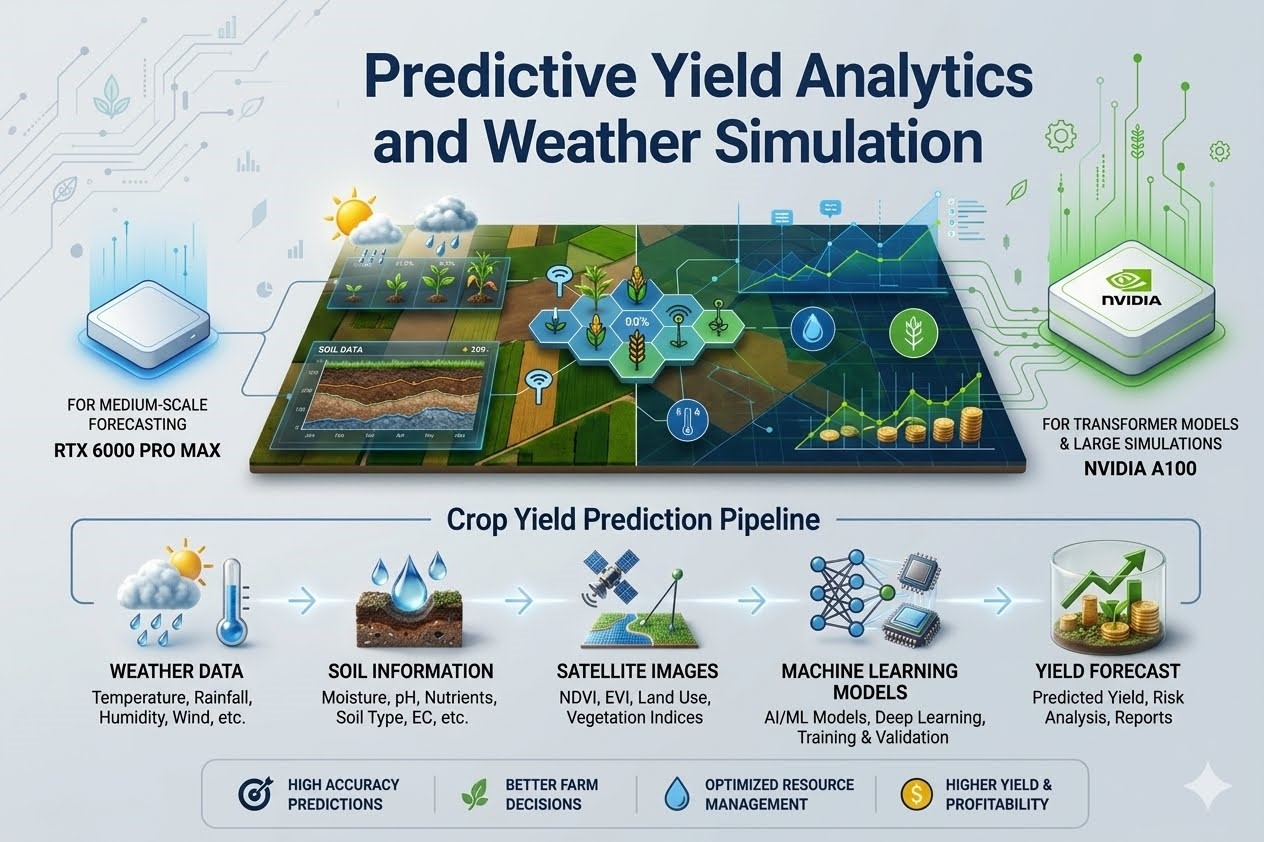
7. Best GPU Servers for Agricultural AI: Predictive Yield Analytics
Best GPU Servers for Agricultural AI Projects can accelerate predictive yield analysis and agricultural weather simulations.
Climate change and environmental uncertainty have increased the importance of predictive analytics in agriculture. Machine learning models analyze historical climate records, rainfall patterns, soil properties, and weather forecasts to estimate crop production and optimize farming strategies.
These models require intensive matrix computations and high memory throughput. Consequently, GPU acceleration allows researchers to process large datasets and generate predictions more efficiently.
The NVIDIA RTX PRO 6000 Blackwell Max-Q performs exceptionally well for medium-scale forecasting projects and academic research environments. On the other hand, the 2x NVIDIA A100 80GB delivers superior performance for transformer-based forecasting models and large agricultural simulations involving massive datasets.
Crop Yield Prediction Pipeline
Weather Data
↓
Soil Information
↓
Satellite Images
↓
Machine Learning Models
↓
Yield Forecast
8. Best GPU Servers for Agricultural AI Projects
Best GPU Servers for Agricultural AI Projects are also useful for training and running agricultural language models.
Selecting the appropriate GPU infrastructure represents one of the most critical decisions for agricultural organizations. Performance requirements, infrastructure costs, scalability, and long-term sustainability must all be considered before deployment.
8.1 NVIDIA RTX PRO 6000 Blackwell Max-Q for Agricultural Computer Vision
The NVIDIA RTX PRO 6000 Blackwell Max-Q is particularly suitable for:
- Drone image analysis
- Crop disease detection systems
- Precision agriculture applications
- Research laboratories and universities
- Medium-scale AI workloads
Advantages
✔ Lower power consumption
✔ Cost-effective deployment
✔ Large memory capacity
✔ Excellent performance for computer vision applications
✔ Suitable for workstation environments
8.2 2x NVIDIA A100 80GB for Enterprise AI Training
The 2x NVIDIA A100 80GB is designed primarily for:
- Large transformer networks
- Distributed deep learning systems
- Climate simulations
- Massive agricultural datasets
- Multi-user AI environments
Advantages
✔ Tensor Core acceleration
✔ High memory bandwidth
✔ Multi-Instance GPU support
✔ Excellent scalability
✔ Suitable for data-center environments
8.3 Cost Comparison Between NVIDIA RTX PRO 6000 Blackwell Max-Q and 2x NVIDIA A100 80GB
The cost of GPU deployment varies according to infrastructure requirements and workload demands. The NVIDIA RTX PRO 6000 Blackwell Max-Q offers an economical solution for medium-scale AI applications and local development environments.
Organizations with limited budgets often prefer workstation-based systems because they require less cooling infrastructure and lower power consumption.
Conversely, the 2x NVIDIA A100 80GB is optimized for enterprise environments and large AI clusters. Although infrastructure costs are higher, organizations benefit from superior scalability and exceptional computational performance. Therefore, the final choice depends on workload complexity, available resources, and long-term research objectives.
Technical Comparison
| Feature | NVIDIA RTX PRO 6000 Blackwell Max-Q | 2x NVIDIA A100 80GB |
| Memory Capacity | 48 GB | 80 GB |
| Architecture | Ada Generation | Ampere |
| Memory Bandwidth | 960 GB/s | 2.0 TB/s |
| Power Consumption | 300 W | 400 W |
| Deployment Environment | Workstation | Data Center |
| Relative Cost | Lower | Higher |
Relative AI Training Performance
AI Training Performance
NVIDIA RTX PRO 6000 Blackwell Max-Q ████████████
2x NVIDIA A100 80GB ████████████████████
8.4 Hardware Architecture Specifications and Deep Learning Compute Benchmarks
| Feature / Metric | NVIDIA RTX PRO 6000 Blackwell Max-Q | NVIDIA A100 80GB SXM4 | NVIDIA A100 80GB PCIe |
| GPU Architecture | Blackwell | Ampere | Ampere |
| Execution Model | SIMT | SIMT | SIMT |
| VRAM Capacity & Type | 96 GB GDDR7 ECC | 80 GB HBM2e ECC | 80 GB HBM2e ECC |
| Memory Bandwidth | ~1.79 TB/s | 2.03 TB/s | 1.93 TB/s |
| Max Power (TDP) | ~300 W | 400 W | 250 W |
| Tensor Cores | 5th-Gen Tensor Cores | 3rd-Gen Tensor Cores | 3rd-Gen Tensor Cores |
| FP16 Tensor Compute | ~360 TFLOPS | 624 TFLOPS (With Sparsity) | 624 TFLOPS (With Sparsity) |
| BF16 Tensor Compute | ~360 TFLOPS | 312 TFLOPS | 312 TFLOPS |
| FP8 Compute Support | Native Hardware Support | Not Supported | Not Supported |
| Multi-GPU Interconnect | Workstation Cluster NVLink | Enterprise NVLink (600 GB/s) | Enterprise NVLink (600 GB/s) |
| Multi-Instance GPU (MIG) | Not Supported | Supported (Up to 7 Instances) | Supported (Up to 7 Instances) |
| YOLOv8 Inference 4K | ~115 FPS (Batch Size 32) | ~142 FPS (Batch Size 32) | ~130 FPS (Batch Size 32) |
| ResNet-50 Training | ~2,100 images/sec (FP8 Scaled) | ~2,950 images/sec (FP16 Native) | ~2,600 images/sec (FP16 Native) |
9. Autonomous Robotic Weeding and Precision Harvesting
Agricultural robotics
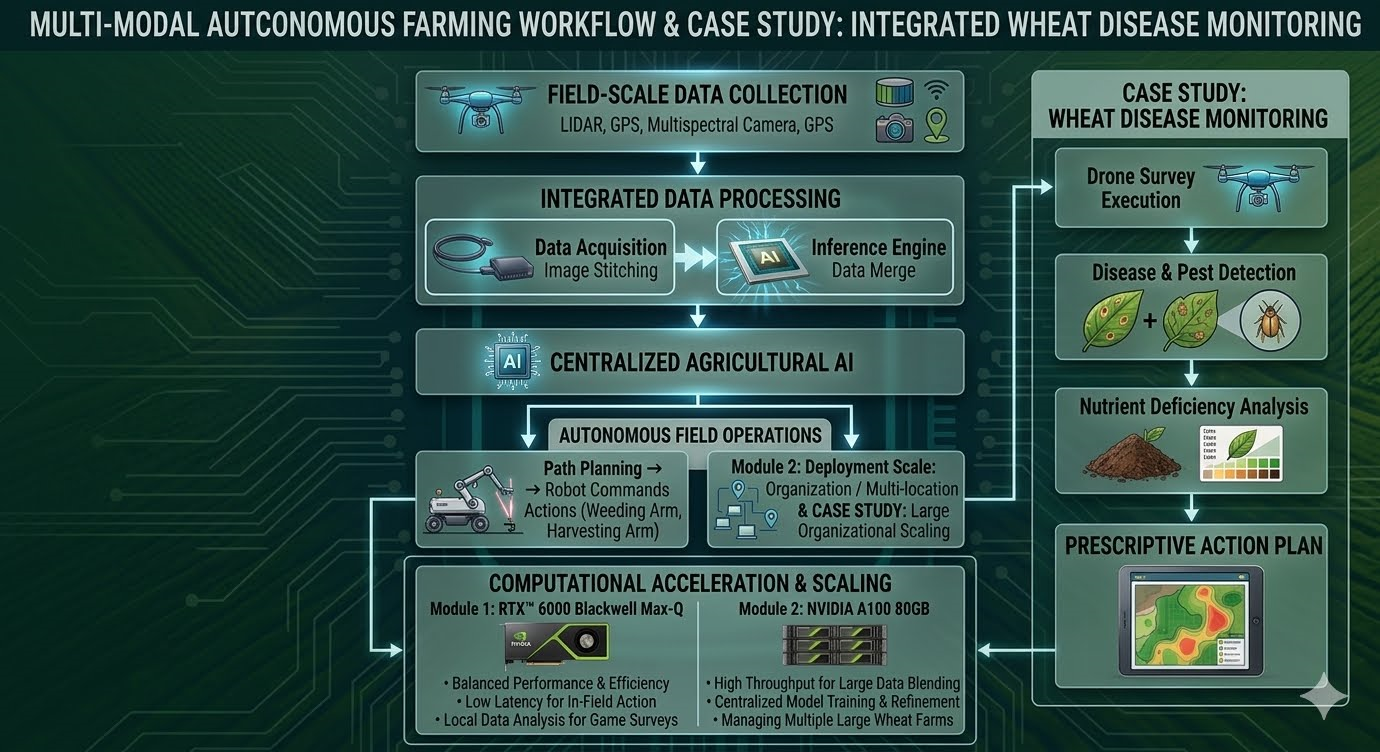
Artificial intelligence has transformed agricultural robotics by improving efficiency and reducing labor requirements. Autonomous tractors, robotic weed-removal systems, and precision harvesting machines are increasingly being adopted across modern farms. These systems depend on computer vision, machine learning, and sensor fusion technologies to operate with minimal human intervention.
Modern agricultural robots continuously collect information through cameras, GPS modules, and LiDAR sensors. Furthermore, deep learning models analyze these data streams in real time to identify weeds, estimate crop maturity, and guide harvesting operations. As a result, such applications require low-latency processing to function effectively.
The NVIDIA RTX PRO 6000 Blackwell Max-Q provides an excellent balance between computational power and energy efficiency, making it suitable for research laboratories and regional agricultural institutions. In contrast, organizations processing massive robotic datasets often prefer the 2x NVIDIA A100 80GB because of its superior throughput and support for distributed training.
AI-Based Autonomous Farming Workflow
Field Sensors
↓
Camera Images
↓
Computer Vision Models
↓
Robotic Decision System
↓
Precision Harvesting
10. Foundation Agricultural Language Models (Ag-LLMs)
Large Language Models are becoming increasingly valuable in agricultural research and decision support systems. Agricultural Language Models (Ag-LLMs) provide recommendations regarding irrigation schedules, fertilizer applications, crop diseases, and weather-related risks. These systems are trained using agricultural databases, scientific literature, weather records, and historical farming information.
Training transformer models requires billions of parameters and extensive computational resources. Specifically, the 2x NVIDIA A100 80GB has become one of the most widely used accelerators for transformer architectures because of its Tensor Core technology and scalability. Consequently, organizations developing enterprise-level AI assistants and agricultural knowledge systems frequently utilize A100 clusters to achieve high performance.
The NVIDIA RTX PRO 6000 Blackwell Max-Q is more suitable for inference tasks and medium-sized AI assistants. For this reason, research institutions and universities often employ workstation-based systems for experimentation and local deployment. Moreover, as agricultural language models continue to evolve, GPU acceleration will become increasingly important for supporting intelligent advisory systems.
Agricultural Language Model Training Pipeline
Agricultural Dataset
↓
Data Processing
↓
GPU Server
(NVIDIA RTX PRO 6000 Blackwell Max-Q / 2x NVIDIA A100 80GB )
↓
Model Training
↓
AI-Based Recommendations
11.Case Study
11.1 Drone-Based Wheat Disease Monitoring
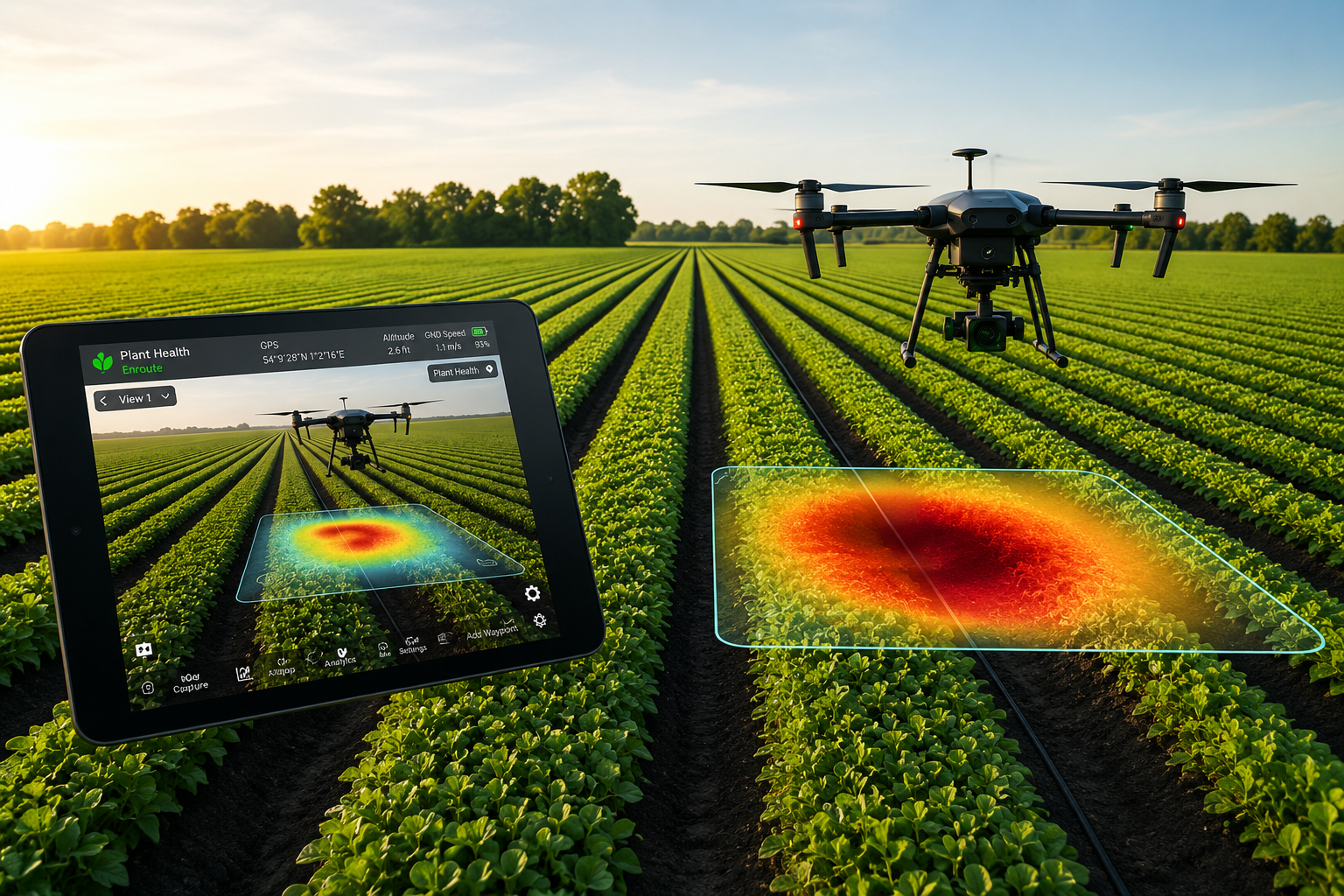
A commercial wheat farm conducts regular drone surveys to monitor crop health across large fields. The collected field data is analyzed to identify signs of fungal infections, pest activity, and nutrient deficiencies before they become serious problems.
Processing large amounts of drone survey data requires significant computing power. GPU servers help accelerate this process, allowing agricultural teams to analyze field conditions more efficiently and respond more quickly to potential issues.
For medium-scale deployments, the NVIDIA RTX PRO 6000 Blackwell Max-Q offers strong performance and cost efficiency. On the other hand, for larger agricultural organizations managing data from multiple locations, the NVIDIA A100 80GB provides greater scalability and computational capacity.
💡 If you want to buy or rent high-performance dedicated GPU servers, click here to explore our https://helloserver.tech/store/index.php/store/gpu-dedicated-servers/2x-nvidia-a100-80gb-2x-intel-xeon-gold-6336y-240ghz-24-cores-960gb-nvme checkout the https://helloserver.tech/store/index.php/store/gpu-dedicated-servers/1x-nvidia-rtx-pro-6000-blackwell-max-q configurations available on HelloServer.
12. Discussion
12.1 Memory Bottlenecks and Vector Configurations
Best GPU Servers for Agricultural AI Projects must be carefully configured to handle memory, power, cooling, and scalability requirements.
Memory bandwidth plays a fundamental role in determining GPU performance. Agricultural datasets generated from drones, satellite imagery, weather stations, and IoT devices continue to increase in complexity. Training deep learning models on these datasets requires continuous movement of information between memory and processing units. Insufficient memory bandwidth can create bottlenecks that reduce computational efficiency.
The NVIDIA RTX PRO 6000 Blackwell Max-Q provides 48 GB of memory and delivers excellent performance for computer vision applications and medium-scale AI workloads. In comparison, the 2x NVIDIA A100 80GB provides 80 GB HBM2e memory and substantially higher bandwidth, allowing large neural networks and transformer models to execute more efficiently.
Deep learning frameworks also rely heavily on vectorized operations to accelerate matrix calculations. Efficient vector configurations improve throughput and reduce training time, enabling researchers to process large agricultural datasets with greater accuracy and speed.
Memory Characteristics
| Parameter | NVIDIA RTX PRO 6000 Blackwell Max-Q | 2x NVIDIA A100 80GB |
| Memory Capacity | 48 GB | 80 GB |
| Memory Type | GDDR6 | HBM2e |
| Memory Bandwidth | 960 GB/s | 2.0 TB/s |
| AI Training Capability | High | Very High |
12.2 Architectural Performance: SIMT versus MIMD
Central Processing Units are designed according to Multiple Instruction Multiple Data (MIMD) architecture, which makes them highly effective for sequential and general-purpose computing tasks. GPUs employ Single Instruction Multiple Data (SIMT) architecture, enabling thousands of cores to execute parallel operations simultaneously.
Agricultural applications such as remote sensing, disease detection, and weather forecasting involve billions of mathematical computations. Fortunately, modern GPUs accelerate these workloads considerably and deliver significantly higher performance than traditional CPU-based systems.
To fully exploit GPU capabilities, developers must utilize CUDA frameworks and optimize memory access patterns. Software optimization remains equally important as hardware performance.
12.3 Pinned Memory and Data Transfer Overheads
Large agricultural datasets often exceed available GPU memory. High-resolution drone images and satellite datasets require continuous communication between system RAM and graphics memory. Data transfer latency therefore becomes a major performance challenge.
Pinned memory techniques improve communication speed and reduce delays during data movement. Faster transfer rates allow neural networks to spend more time performing computations rather than waiting for data loading processes.
Efficient memory management strategies, asynchronous transfers, and optimized batch processing help maximize throughput and maintain high GPU utilization.
12.4 Power Infrastructure and Thermal Profiles
Power consumption and cooling requirements are important considerations when selecting GPU servers. The NVIDIA RTX PRO 6000 Blackwell Max-Q consumes approximately 300 watts and operates efficiently within workstation environments. This makes it an attractive solution for universities, research laboratories, and medium-scale agritech companies.
The 2x NVIDIA A100 80GB consumes approximately 400 watts and is intended primarily for enterprise data centers. Multi-GPU clusters require advanced cooling systems and dedicated power infrastructure. Although deployment costs are higher, organizations benefit from superior scalability and computational performance.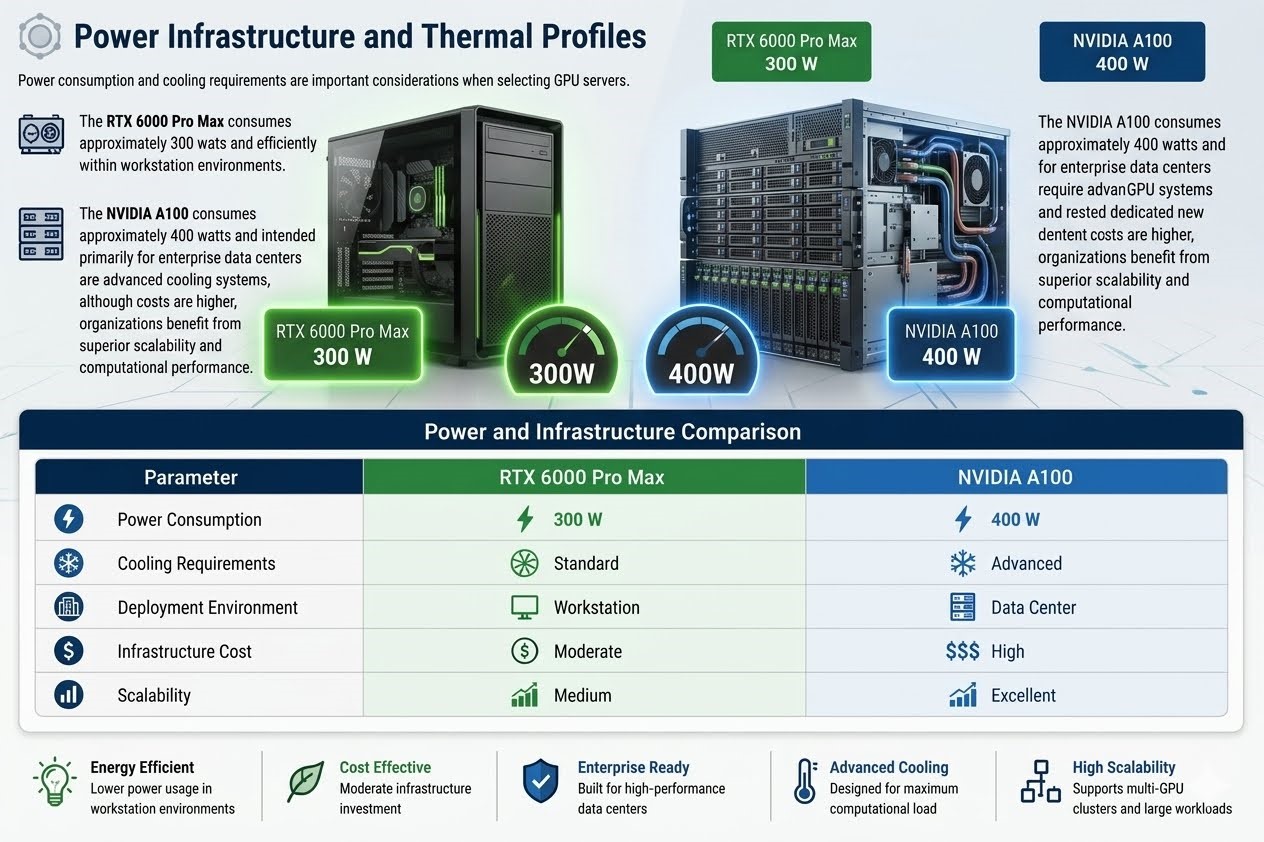
Power and Infrastructure Comparison
| Parameter | NVIDIA RTX PRO 6000 Blackwell Max-Q | 2x NVIDIA A100 80GB |
| Power Consumption | 300 W | 400 W |
| Cooling Requirements | Standard | Advanced |
| Deployment Environment | Workstation | Data Center |
| Infrastructure Cost | Moderate | High |
| Scalability | Medium | Excellent |
12.5 Multi-Instance GPU (MIG) Virtualization
Efficient resource allocation has become increasingly important in AI research environments. The 2x NVIDIA A100 80GB supports Multi-Instance GPU (MIG) technology, allowing a single physical accelerator to be divided into multiple isolated environments.
This capability enables several users to execute independent workloads simultaneously. For example, one research group can perform crop disease analysis while another executes climate simulations using the same hardware resources. As a result, such virtualization improves hardware utilization and reduces infrastructure costs.
Although the NVIDIA RTX PRO 6000 Blackwell Max-Q provides excellent workstation performance, it lacks native Multi-Instance GPU support. Therefore, organizations requiring large-scale resource sharing often prefer enterprise accelerators such as the 2x NVIDIA A100 80GB .
12.6 Future Trends and Emerging Opportunities
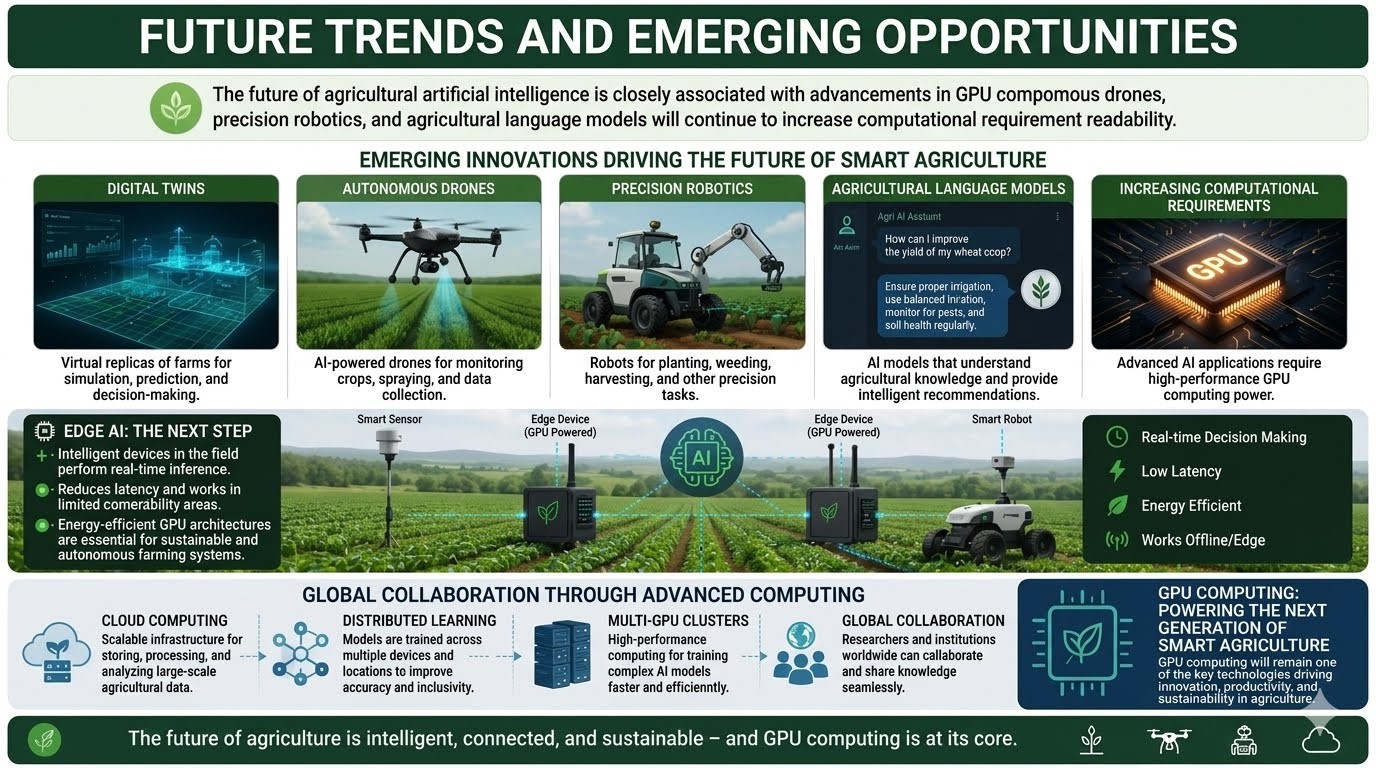
The future of agricultural artificial intelligence is closely associated with advancements in GPU computing and machine learning technologies. Emerging innovations such as digital twins, autonomous drones, precision robotics, and agricultural language models will continue to increase computational requirements.
Edge AI is another rapidly expanding area in modern farming. In this setup, intelligent devices deployed directly in agricultural fields will perform real-time inference without relying entirely on cloud computing. Therefore, energy-efficient GPU architectures will play a crucial role in future farming systems.
Cloud computing, distributed learning, and multi-GPU clusters are expected to improve collaboration among researchers worldwide. These developments indicate that GPU computing will remain one of the key technologies driving the next generation of smart agriculture.
13. Conclusion
Artificial intelligence is transforming agriculture through precision farming, disease detection, predictive analytics, and autonomous machinery. As agricultural systems become increasingly dependent on machine learning and data-driven decision-making, selecting the appropriate GPU infrastructure becomes essential for maximizing performance and scalability.
The NVIDIA RTX PRO 6000 Blackwell Max-Q provides an excellent solution for computer vision applications, drone image analysis, and workstation-based AI development. Furthermore, its combination of computational performance, energy efficiency, and affordability makes it highly suitable for universities, research laboratories, and medium-scale agricultural projects.
In contrast, the 2x NVIDIA A100 80GB is optimized for enterprise-scale artificial intelligence, climate simulations, transformer networks, and distributed deep learning systems. Specifically, its Tensor Core acceleration, high memory bandwidth, and Multi-Instance GPU capabilities enable organizations to process massive datasets efficiently.
Ultimately, choosing the right Best GPU Servers for Agricultural AI depends on workload requirements, budget limitations, and infrastructure capabilities. Organizations that align their GPU resources with their computational needs will be better positioned to develop sustainable, intelligent, and highly productive agricultural systems.
References
[1] NVIDIA Corporation, NVIDIA RTX PRO 6000 Blackwell Max-Q Workstation Edition Technical Overview, 2025.
[2] NVIDIA Corporation, NVIDIA A100 Tensor Core GPU Architecture Whitepaper, 2020.
[3] NVIDIA Corporation, CUDA Toolkit Documentation, NVIDIA Developer Documentation.
[4] NVIDIA Corporation, TensorRT Developer Guide, NVIDIA Developer Documentation.
[5] Food and Agriculture Organization (FAO), Artificial Intelligence and Digital Technologies in Agriculture.
[6] S. Kamilaris and F. X. Prenafeta-Boldú, “Deep Learning in Agriculture: A Survey,” Computers and Electronics in Agriculture, vol. 147, pp. 70–90, 2018.
[7] IEEE Research Publications, Deep Learning Applications in Precision Agriculture and Crop Monitoring.
[8] Springer Nature, Artificial Intelligence Applications in Smart Agriculture and Precision Farming.
[9] Journal of Agricultural Informatics, Machine Learning Applications for Precision Agriculture and Crop Monitoring.